
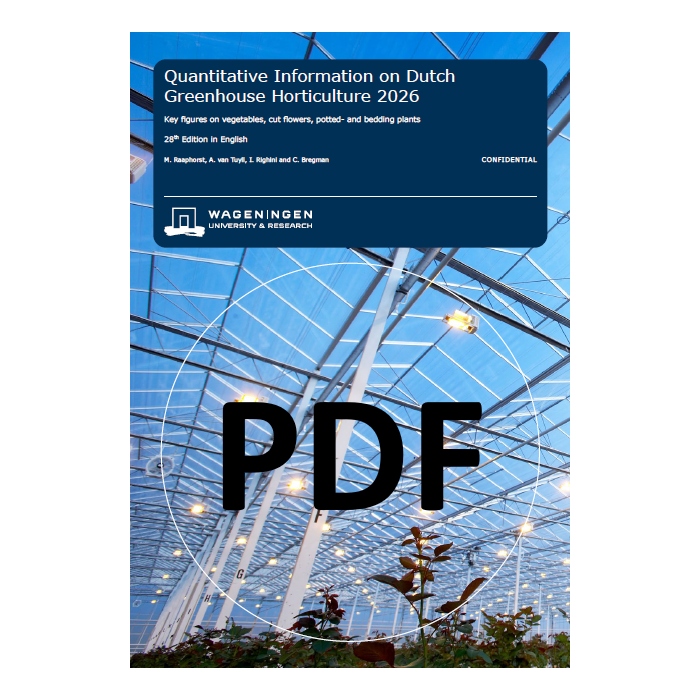
KWIN Greenhouse Horticulture 2026 (pdf)
Foreword 3
Summary 7
1 How to convert Dutch greenhouse crop information to local situations 9
1.1 Outdoor climate 9
1.2 Location and production equipment 10
1.2.1 Knowledge level and education of staff 10
1.3 Market 11
2 Information on the Dutch horticultural sector 12
2.1 Acreage, number of companies and size of companies 12
2.1.1 Acreage and number of companies 12
2.1.2 Number of companies and company size 14
2.1.3 Acreage by crop 17
2.1.4 Area and size by region 20
2.2 Production value of floriculture in Europe 22
2.3 Acreage and production of greenhouse vegetables in Europe 23
2.3.1 Tomato 23
2.3.2 Bell pepper 24
2.3.3 Cucumber 25
2.3.4 Strawberry 26
2.3.5 Lettuce 27
3 Production assets and equipment 28
3.1 Land 28
3.2 Energy 30
3.2.1 Consumption by greenhouse horticulture 30
3.2.2 CHP use 31
3.2.3 Breakdown of natural gas costs 32
3.2.4 Natural gas purchase 33
3.2.5 Electricity costs 34
3.2.6 Spark spread 37
3.2.7 Tax 38
3.2.8 Illustrative calculation of total variable energy costs 40
3.2.9 Geothermal heat 41
3.3 CO₂ 43
3.3.1 Crop CO₂ requirement 43
3.3.2 CO₂ levy for greenhouse horticulture 44
3.4 Lighting 44
3.5 Fertigation 46
3.5.1 Crop water demand 46
3.5.2 Water costs 47
3.5.3 Nutrients 49
3.6 Production assets 50
3.7 Total purchase price and annual costs of production assets 67
4 Explanation of budget estimates and cost calculations 70
4.1 General 70
4.2 Yield 70
4.3 Revenues and cost price 71
4.4 Price level of energy and CO₂ 71
4.4.1 Gas and electricity 71
4.4.2 CO₂ 71
4.5 Allocated costs (direct costs) 72
4.5.1 Definition 72
4.5.2 Plant material 72
4.5.3 Substrate 72
4.5.4 Electricity 72
4.5.5 Purchased CO₂ 73
4.5.6 Miscellaneous materials 73
4.5.7 Labour 73
4.5.8 Subcontractors 73
4.5.9 Crop residue disposal 73
4.5.10 Transport costs product 73
4.5.11 Packaging and containers 73
4.5.12 Sales costs 74
4.5.13 Interest on investment 74
4.5.14 Perennial crops 74
4.6 Indirect costs 74
4.6.1 Durable production assets and land 74
4.6.2 Natural gas consumption and electricity generation 74
4.6.3 Crop protection 75
4.6.4 Water 75
4.6.5 General costs and hours 75
4.7 Labour budgets and costs 76
4.8 Balance, net operating result, margin and profitability 76
4.9 Carbon footprint 77
4.10 Assumptions for balance sheet budgets 78
5 Additional explanation of the balance and operating results of potted plants 80
5.1 Types of space utilisation 80
5.1.1 Technical space utilisation 80
5.1.2 Organisational space utilisation 81
5.2 Use of balance and business result budgets 81
5.3 Explanation of cost categories 82
5.4 Explanation on labour standards for potting plants 84
6 Balance sheet and cost price calculation for vegetables 86
7 Balance sheet and cost price calculation for cut flowers 132
8 Balance sheet and cost price calculation for potted plants 197
9 Balance sheets and cost price calculation for bedding and container plants 243
10 Translations 260
10.1 La traduction française 261
10.2 Traducción española 263
10.3 Deutsche Übersetzung 265
References 267
Earlier Editions of Kwantitatieve Informatie voor de Glastuinbouw (KWIN) 268
Bent u op zoek naar iets specifieks?
Heeft u vragen over onze producten? U kunt ons bereiken via webshop.kwin@wur.nl of stel u vraag aan de specifieke onderzoeker.
Quantitative Information on Dutch Greenhouse Horticulture is a regular publication that provides current and comprehensive data on production, product prices, and production resources and assets. It offers economic figures, including balance sheets with revenue and cultivation-related costs, which are essential for cultivation and investment plans.
The information presented in this book primarily serves as a resource for greenhouse horticulture companies, enabling growers to draw up business and economic advice independently or in collaboration with information and advisory institutions. Additionally, this information holds significance for various stakeholders involved in greenhouse horticulture, such as suppliers, accounting firms, banks, and educational institutions.
This 28th edition of the book, released in 2026, includes several notable updates compared to previous years. This edition includes:
- Insights into the sector, including area, the number of farms, and farm sizes in the Netherlands, along with
- estimates for other European countries.
- Estimates of crop production for various significant crops in Europe.
- Investment costs for production assets.
- Budgets detailing cost prices for essential greenhouse vegetables, cut flowers, and pot and bedding plants.
- Breakdown of electricity and CO₂ supply per period.
- CO₂ footprint analysis per crop, including the impact of the different production resources involved.